In the Parable of the Good Samaritan, Jesus teaches us the profound lesson of loving our neighbor. The Samaritan, an unlikely hero, saw a wounded man and showed him compassion, while others passed by. This story challenges us to go beyond societal boundaries and personal prejudices, extending kindness to all, even those we might consider strangers or enemies. In our daily lives, we are called to act as the Samaritan did—offering help without hesitation and loving others as ourselves. May we open our hearts to God’s love, reflecting it through our actions towards everyone we encounter.
100 words on ‘being’ between Heidegger and Levinas
Heidegger and Levinas both explore the concept of being, but from different perspectives. Heidegger’s existential analysis in “Being and Time” focuses on “Being” as the essence of human existence, emphasizing individual authenticity and the nature of existence itself. For Heidegger, understanding being involves confronting our own mortality and the concept of “Being-toward-death.”
Levinas, on the other hand, critiques Heidegger’s approach, arguing that it overlooks the ethical dimension of existence. In “Totality and Infinity,” Levinas prioritizes the “Other” and the ethical responsibility we have towards others. While Heidegger seeks to understand existence in isolation, Levinas emphasizes relational ethics and responsibility as central to being.
100 words on Another Person’s Moment
Gazing at another person’s moment in time involves deeply witnessing and appreciating their unique experiences and emotions. It’s an act of empathy that transcends mere observation, allowing one to connect with another’s lived reality. This perspective fosters understanding and compassion, revealing the intricate tapestry of individual lives. By focusing on these moments, we acknowledge the significance of each person’s journey, recognizing their struggles, joys, and transformations. This practice encourages a profound respect for others’ experiences and fosters a sense of shared humanity, reminding us that each moment is a vital part of the broader human story.
Every career option seemed to come to me as a favor. My first job was a favor from a friend, FR, from KAMI (Kulturang Aming Minana). I jumped at it because it was 1984, I had graduated from college, and I didn’t like to stay idle and jobless. As the eldest in the family, I felt guilty staying at home, even though I was also busy with ‘art-for-art’s sake’ things. My degree of Bachelor of Arts major in English seemed useless.
KAMI had by that time long concluded its theatrical productions and I was listless. F was officially a medical representative for Pascual Laboratories Pharmaceuticals Inc., but he moonlighted as a freelance artist and subcontracted his Batangas coverage area to me. The job was to cover physicians in Lemery and Lipa, to promote Betadine Povidone Iodine, Pascual’s main product line. Eventually, I applied to Pascual, thus I became one of its sales representatives from 1984 to 1985. It was a strange first job: since I was much given to introspection, I often spaced out in hospitals, missed my doctor calls and failed to meet my sales quota. Despite my bombast and aplomb at the product training, I was a total failure in the social field of sales and promotion.
Walang Sugat
In the theater group called KULTURANG AMING MINANA [KAMI], FR was the stage director, and DR, his wife was the voice instructor. They found us as Tanghalang Dalwa Singko via PETA and gave us an audition. Once they’ve chosen their cast, they directed and managed their presentation of the zarzuela ‘Walang Sugat’ in Tanauan first, then in Batangas City. We held our production with tickets at the St. Bridget’s Auditorium in 1980. The original libretto presented at CCP was the very same libretto we acted and sang at the SBA, but much abridged to accommodate our limited voice range and lack of training in musical theater.
Sa Langit Walang Beer
F and D were probably trying to establish themselves as independent producers, and for their foray into provincial theater, they conducted theater workshops and began a series of stage plays in Tanauan. We presented at least two plays in Tanauan Cultural Center – Sa Langit, Walang Beer, and excerpts of Walang Sugat. Then, F and D collaborated with PETA on the production of Carlos P. Romulo’s Daughter’s for Sale, to showcase in Intramuros theater that same year. DFS became KAMI’s final production, and my part in that play was another tale about me being ‘favored’.
Daughters for Sale
The 1980s was a time of unrest for most Filipinos who were haunted by the horrors of martial law. Focus magazine was one of the more progressive publications at the time. In Intramuros when we presented Daughters for Sale, the lead actress, CC, who was also an editor of Focus, was suddenly unable to perform live because of a threat to her life. As the understudy, I was the immediate substitute to play her role-Rosario-in Daughter for Sale. So I had to wear her costume, say her dialogue, follow her blocking, and interact with fellow actors on stage. As an understudy, I was familiar with the script and blocking of DFS, but I still wasn’t prepared to actually play the part on the actual play date. The love interest of my character was played by actor LV. At the time, I wasn’t intimidated despite his reputation as an excellent actor because I was more conscious about my unfitted costume than of my poor acting. Actress C had a round, full body, while I was paper thin. I felt unwrapped even if I was wearing period clothing. Still, with the help of the other actors, the play began and ended as it should.
The following day [or weekend, I can’t recall] the columnist Crispina Belen thought I winged it, and gave me a warm ‘kudos’ tweet [no Twitter yet in 1981]. She wrote in her column in Bulletin Today, ‘kudos to Jophen Baul’ for her performance in Carlos P. Romulo’s Daughters for Sale. I clipped this public ‘tweet’ in a periodical, totally assuming it was me despite the wrong last name. This clipped memory of my fifteen minutes of fame is a treasured whatnot among my files.
When my mother got ill with cervical cancer, I resigned from my job to be with her. Her body deteriorated slowly until finally, even putting her in a wheelchair could break her fragile bones. Staying long with her at home was not difficult, but I missed the stimulation of the city. Cooped up in our small apartment, I resorted to online translation and flourished.
Our small apartment was the last in five doors and the smallest in square meters. We could hear our neighbors all the time, even when their doors were closed. We had only a ‘right of way’ to our little gate being the last door in five, so I was a body visible to every neighbor as I walked in and out of our house. Ironically, this made me more protective of myself, that I hardly talked or mingled with a neighbor, unless it was Christmas or New Year, when everybody would be out to greet each other and make noise.
WRITING POETRY WITH INAY
Although weak and weary, my mother, Inay, maintained pots of bougainvilleas and San Francisco plants, and some fortune plants as well. She loved her plants, but when she couldn’t any more water them herself, it became another one of my chores.
Working as a translator at night and trying very hard to sleep by day, I always forgot to water those plants and was delinquent as well in cutting and trimming them. But Inay wasn’t complaining. A time came when her periphery of vision was not going beyond the front door. Upon waking up, she would just get up and sit on the bed until she felt the need to relieve herself. She occupied a wooden papag downstairs, while my ‘office’ was upstairs. In the morning before breakfast, I would walk to the market to buy some tamales, or kalamay, or puto and the two of us would have that for breakfast with coffee. During those breakfast hours, she would tell me stories about her younger self, and I savored those moments. The two of us would be eating lunch together while watching Eat Bulaga, and supper together viewing some Teleserye.
When my mother was still able to move in her wheelchair, she prepared and cooked all our food. But when it was not possible anymore to get out of bed, she did not resist when I opted to take out fast food from the nearest restaurant. Sometimes, I tried to cook, however, I could not enjoy the food I cooked. I had always been underweight but with Inay always cooking the food I bought in the wet market, I happily gained weight.
Hopelessly, I went back to being thin again when she stopped cooking.
As my mother weakened, I felt helpless. All the poems I was writing at the time were about her. Whenever I felt too tired and lonely, I often left for a while, took the bus from Batangas City to Makiling in Laguna, and just stared at that lovely mountain for about two hours. Then I would ride the bus again back home. Once home, the only place to be when I was feeling exhausted was the terrace.
VIEW FROM THE TERRACE
copyright (c) Jophen Baui April 4, 2007
I tire myself over a book
Stocking insights for future verses
Otherwise, it is limited to the color and smell
Of spaced-out neighborhood
Devoid of will and yet full
Of natural excesses:
In the vicinity of pots
Creeping vines unnamed and unbecoming
Are as wanton as their dreams.
Indecisive bougainvillea devoid of a trellis
Hanging on to wash lines,
No wind touches a petal of their pink profusion.
Each stem of the neighbor fortune plant
Struggles to be free from juvenile entanglements
Of surreptitious vines clinging to posts
Blackened with secure grime.
Every will of greatness has been tampered.
Pools of mud from overflowing canals
Humid April dulled visions
Immune even to the noise
Of children’s nonsense
That can break through
This weary plainness.
RE-IMAGINING INAY’S POTTED PLANTS
Revising this poem made me re-imagine my mother’s potted plants. After she died, I left our house and went back to Manila. Back on the streets and commuting, I was now seeing the same kind of plants on the road. Some bougainvilleas were planted in some island parts along EDSA. Some plants crept under the overpasses, others fell on their vines from the highest brick of a walled subdivision. At first, I enjoyed the long ride to school when I lived in Cavite after thirteen years of staying in my mother’s house. I always brought a book to read on the bus when traffic stood still. I realized that my time slowed down so I had to speed up. But I somehow enjoyed the unhurried pace and often tried to retrieve images from my mother’s full life.
In my late twenties, when my first real office boss was resigning and about to move on to another job, I wrote him a long thank you poem. He found the old poem today while cleaning up, probably inserted in some pages of one of his many diaries. When I saw a photo-reproduction of my mid 90s poem, I am struck by my self-confidence then, how brave I was to send away a mere colleague with a heartfelt poem! The twelve-stanza rhyming quatrains appears quaint and amateurish to me now. I wouldn’t dare show it to any netizen on Facebook. On hindsight, giving him a poem was boasting about my ability to craft melodic lines. Back then, confident about my skill in Balagtasismo, I gave this fan of my amateur poetry at least three more poems.
Today, an acquaintance from Batangas City gifted her husband with a beautiful poem for their 8th anniversary. The poem in free verse juxtaposes her happiness and fear in loving someone so near, a tribute to their intimate and committed union. Her piercing Tagalog lines is from the voice of someone safely anchored on poetry’s shores. After reading her poetry, I was tempted to upload one poem from my unpublished collection – Hugos. Unfortunately, I lack the courage to exhibit my poems on social media.
The last poems I posted on facebook in 2010 were a series of verses for Inay. As a freelancer managing a website, I occasionally blogged some poems. Since I revised more than I finalized, my poems are never finished. Often when I was done revising, I could hardly recognize the original intention of the poem. I thought that poetry was what I could write best. But I have not published a poem since my mid thirties.
Hugos is a collection of my more than thirty poems recovered and revised from past crafting. Hopefully, they will be bound, stand with a spine, and become a book.
For my book project THINGS, the task was clear: blog about new discoveries using an object in my condo as a writing trigger. But since April 2023, when I officially became a senior citizen, my daily routine has completely shifted. If I’ve made any discoveries, I haven’t faithfully recorded them as reflections inspired by things—a habit I promised myself I’d keep. The major culprit? Still my lack of discipline in consistent writing!
My Tiny Home Office Under the Loft Bed
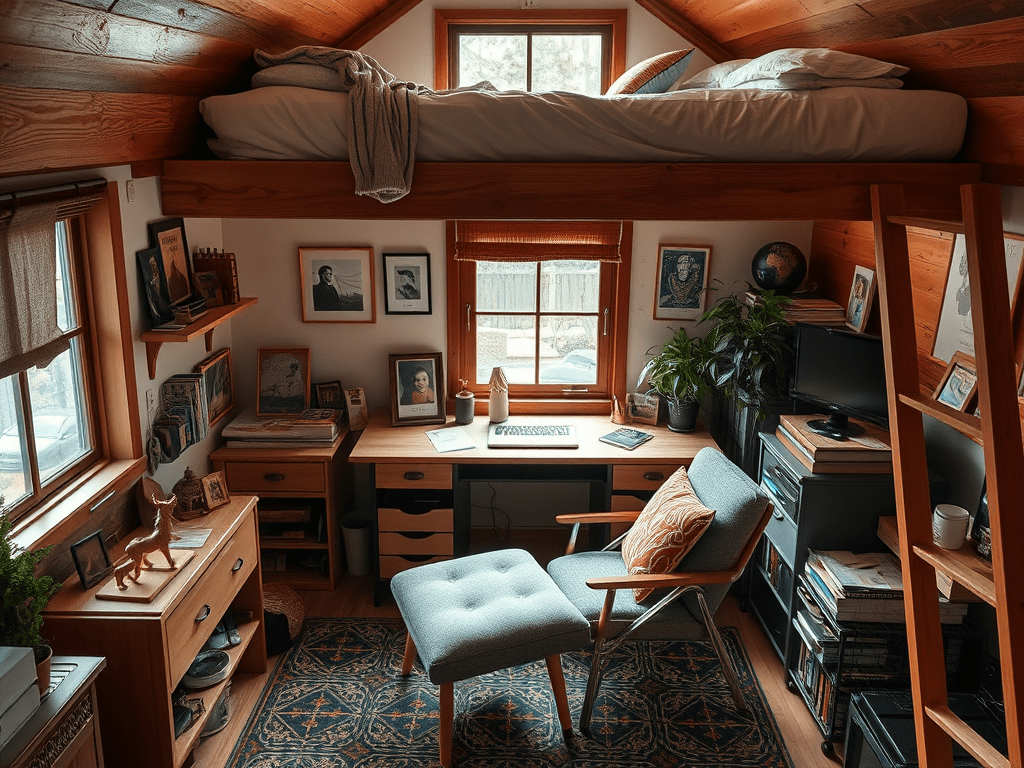
Back in 2022, I installed a loft bed with a stair cabinet and moved my molave desk from the living room to the space under the bed. I designed it so I could sit and stand comfortably—finally, a small writing nook I could call my own. (The image above was my inspiration, though it’s not my actual room.)
This change was necessary because my sister and her son had taken over the entire living room. There’s now a folding study table for my nephew near the stairs and a work desk for my sister beside the front door. I’ve even thought about retrieving my old Narra desk from my brother’s resort in Batangas—the one I got from OMF when they let me work from home during my mother’s illness. That desk, with its deep drawers, could now be a useful storage space for my nephew’s clothes, which currently live in stacked plastic bins under his folding table.
Sharing the Condo Space—and the Chaos
I had a double bed installed for them in the living room, so that space no longer belongs to me. And honestly, that’s fine. Their clutter stays in their corner, and my under-the-loft writing space remains untouched.
To cheer myself up, I bought a new chair—not because it’s ergonomic, but because it looked great in my cozy nook. Unfortunately, it’s not ideal for writing. So, I pulled out my old blue folding metal chair, a trusty companion from my boarding days in Palanan, 2011. It’s not pretty, but it works. Meanwhile, my old rotating desk chair is now with my sister.
Sleeping Like a Senior: Loft Bed Woes and Foam Regrets
My current neck issues all trace back to sleeping on this loft bed in my 35-square-meter condo. Although the high bunk lets me sleep undisturbed by the bathroom traffic of my condo mates, I’m beginning to think it’s time to replace the foam with a flatter one for better sleep support.
Back when I had a proper bed that also served as a sofa, things felt different. My nephew used to hang around my bed more—playing, painting, or just watching the world from the window. Now he has his own space, his own fan, and his own Netflix time. He still occasionally asks if he can sleep beside me, but he’s grown so much, it’s not as comfy anymore. Still, I treasure the mornings when his little face pops up the loft stairs with a cheerful “Good morning Ninang.”
Learning to Blog Again: YouTube, WordPress, and Late-Life Tech
Today, instead of blogging about any exciting new discovery (because, frankly, I don’t have one), I spent half the day on YouTube learning about productive blogging for beginners and senior citizen content creators. I googled tutorials on how to manage my still-green websites. At my age, these technical things take time to understand. But I’m learning.
Hostinger Academy introduced me to a list of no-code web-building tools. Even though WordPress wasn’t on that list, Hostinger still directs me to it. I’ve been blogging on WordPress and slowly updating my confidantesite.blog one post at a time. At first, I was completely confused by the tutorials. But over time, I got used to spending hours learning how to build and maintain a basic website.
Missing SiteSell—and Discovering the Magic of ChatGPT
I honestly miss SiteSell, my old web host from 2004 to 2021. It was great for senior bloggers like me—full tutorials, easy troubleshooting, and clear directions. I used SiteBuildIt for WP, but I’m considering unsubscribing. Why? Because SEO tweaking is now so much easier with the help of ChatGPT—from crafting meta descriptions to generating keywords and content ideas.
Embracing My Tech-Challenged Self (with Help from AI)
In this little under-the-bunk writing cave, I think I’m doing okay navigating the digital world as a senior citizen. If you, my rare reader, want to learn the tools I use, just ask—though honestly, ChatGPT probably explains them better than I can.